13 min read
On the Road · Granfondo: Ultra Distance, Great Perseverance
The Granfondo is not a race against others. It is a slow, solitary, honest confrontation with one's own body. In the mountains of Yunnan, 130 kilometers is not a number — it is three hours of specific, concrete time you must move through.
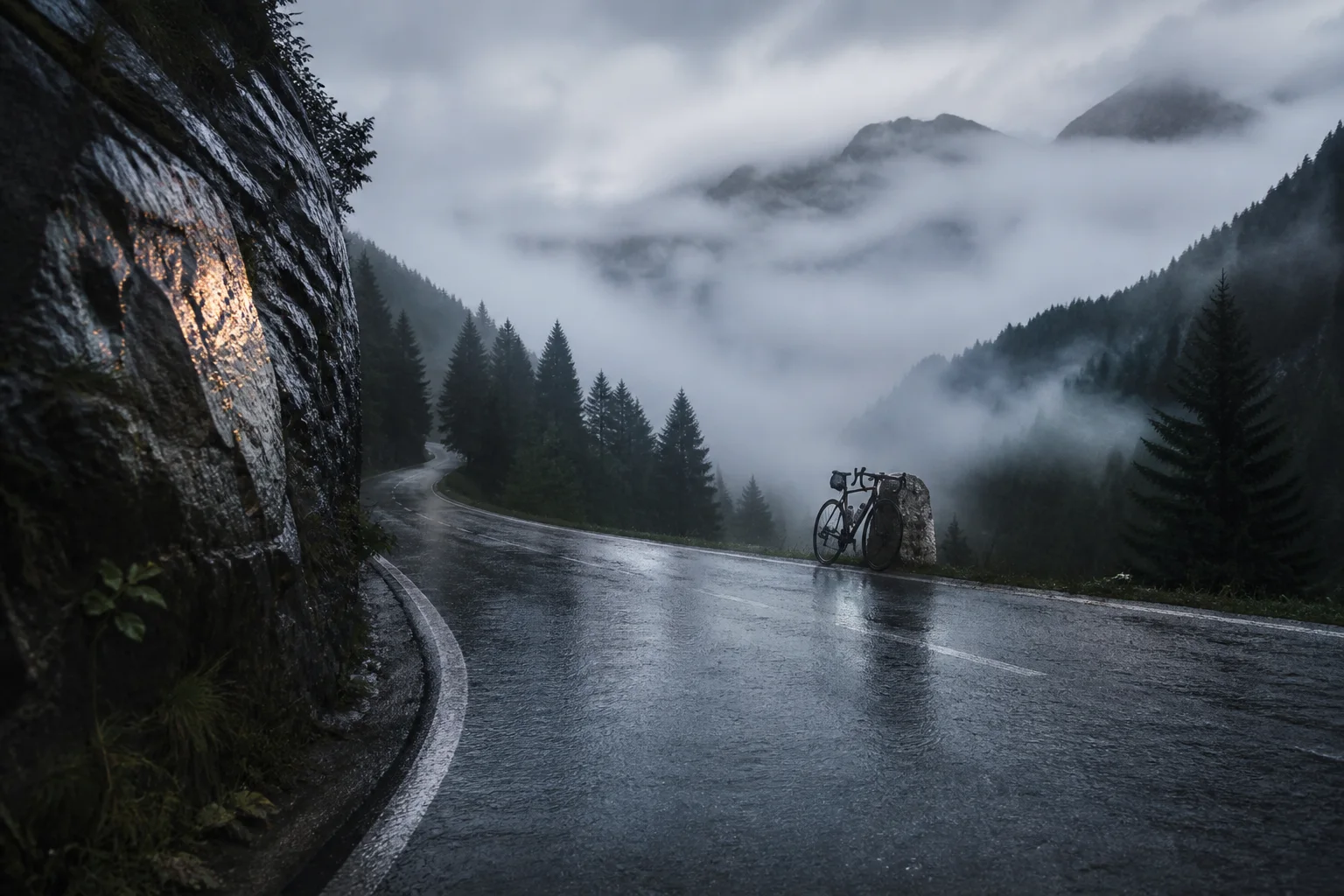
The Granfondo is not a race.
It is 130 kilometers. Starting from Lijiang, passing through Baisha and Shuhe, then the climbing begins. The shadow of Jade Dragon Snow Mountain appears suddenly at some bend, then vanishes just as suddenly. There is not much to see on this stretch. Only the road under your wheels, the drainage ditches at the roadside, the occasional horse droppings left by passing carts.
At forty kilometers, the body enters an unfamiliar state. Fat burning has taken over completely, blood sugar has dropped, the legs begin to feel a strange dull ache — not soreness, but emptiness. The legs are like two empty cylinders: still turning, still working, but with nothing left to burn.
This has a name among cyclists. They call it “hitting the wall.”
But there is no wall on the Granfondo. Yunnan’s mountains are not opposing you — they are simply existing in their own place. They do not care if you ride fast or slow, if you are in good form or not. They are simply there.
130 kilometers in Yunnan’s mountains is not a number.
It is a specific, concrete span of time — three hours you must cross, step by step.
The smell of the Granfondo begins at Baisha.
Baisha is an ancient Naxi town at the foot of Jade Dragon Snow Mountain, elevation 2,400 meters. The old street is lined with timber-frame houses whose wood has been saturated by decades of life — smoke from cooking fires, rain seeping into the beams, moss growing at the base of walls. These smells layered together are the smell of Baisha.
When a bicycle passes through Baisha’s old street, you catch these smells. But only for a moment. A few seconds later, you are already through, and ahead there is only mountain and road.
The smell on Yunnan’s mountain roads is stratified by altitude.
Below 1,500 meters: the smell of villages — cooking smoke, freshly turned earth, furrows in a plowed field, the smell of cow dung, the scent of wood fire from farmhouse kitchens. Above 2,000 meters, plant smells begin to thin, and the air takes on a faintly cool quality — not from temperature, but from the thinness of the air. This “clearness” is the result of reduced oxygen: the olfactory nerves simply fire more slowly.
Above 3,000 meters, the smell of rock dominates. Limestone under the high plateau sun releases a faintly alkaline scent — another way of saying “clean.” Clean at high altitude is not a sense of sanitation; it is the near-absence of volatile organic compounds in the air, so that the olfactory system receives almost nothing worth registering.
This is the specific olfactory experience of cycling at altitude. At high elevation, the olfactory system enters a state similar to meditation: no noise, no interference, only a few signal sources — from which direction the wind is coming, what it carries, how far that smell is from you.
Granfondo riders develop a specific capacity: in moments of extreme exhaustion, they can smell more clearly than at any other time.
This is not an illusion. It is the result of attentional reallocation. After the third or fourth hour of a long ride, the brain begins to actively shut down unnecessary perceptual channels — peripheral vision narrows, auditory sensitivity decreases — but smell does not. Smell is the only sense that consumes almost no cognitive resources during exercise.
So after hitting the wall, you begin to smell more: pine needles in the wind, wood smoke drifting from some distant village, the damp valley-bottom smell rising from a gorge below.
One rider said: “After a hundred kilometers, I finally realized this road has a smell. The first hundred kilometers I was only cycling. The last thirty, I began to smell the road.”
What he meant: the first hundred kilometers, the body was working. The last thirty, the body could finally rest — it was simply turning with the wheels — and so the senses finally opened.
There is a specific quality of dampness in Yunnan’s mountains.
Not from rain — the Granfondo is held in November, Yunnan’s dry season, the sky white-blue under fierce sun, not a cloud. But the air still carries a damp quality.
This dampness comes from the gorges. The Jinsha and Lancang rivers have cut countless gorges through Yunnan, and the moisture at the bottom of those gorges is heated during the day, rises to mid-mountain, gets trapped by an inversion layer, then spreads laterally at that altitude. This “suspended dampness” has no source, no shape, no weight — it simply exists in the air.
The name for this smell is valley-bottom air.
Valley-bottom air is the gas molecules released by plants and water bodies at the gorge floor, carried upward by convection, trapped at a specific inversion structure when they reach mid-elevation, unable to rise further or dissipate — only to move laterally. Cyclists ride through it but cannot feel it moving. It simply makes the air feel “heavier” than the actual humidity reading suggests.
This is what makes cycling in Yunnan’s mountains singular: there is always something invisible wrapping around you. The mountains ahead are visible, but the layer of dampness in the air is not. It is the background, the ground color, present from kilometer one to kilometer one hundred thirty.
In the last thirty kilometers, the Granfondo passes through a pine forest.
The forest is on the eastern slope of Jade Dragon Snow Mountain, at approximately 2,600 meters elevation. The smell inside that pine forest is the most “complete” smell in Yunnan’s mountains: the sharpness of pine resin, the bitter cleanliness of pine needles, the dampness of moss in the shaded understory — these three layers combine into a standard “high-altitude forest” scent.
But this is not what you are meant to remember. What you are meant to remember is that, in some city afternoon, months later, it will suddenly come back to you.
Riders who finish the Granfondo rarely speak at the finish. They sit on the ground, or lean against their bicycles, waiting for their legs to slowly recover. The shadow of Jade Dragon Snow Mountain begins to lengthen at three in the afternoon; by four, it covers half the finish area.
At this point, they smell the finish area: the smell of a completed certificate, the smell of energy gel wrappers, the faintly salty mineral scent left when sweat evaporates from the skin.
Salt is the last smell the Granfondo leaves on the body.
Salt is mineral.
The smell of mineral is the smell of perseverance.
Associated notes: [Woody] [Mineral] [Wetland]