8 min read
On the Road - Climbing: The Cleanliness of Rock Walls Is a Place Without Scent
Climbers on rock walls do not smell scents. Not that they do not want to smell; rock walls have no scent. Clean to the point of having no scent is the highest rock wall. Clean is weathered rock, emitting its final, irreducible molecules.
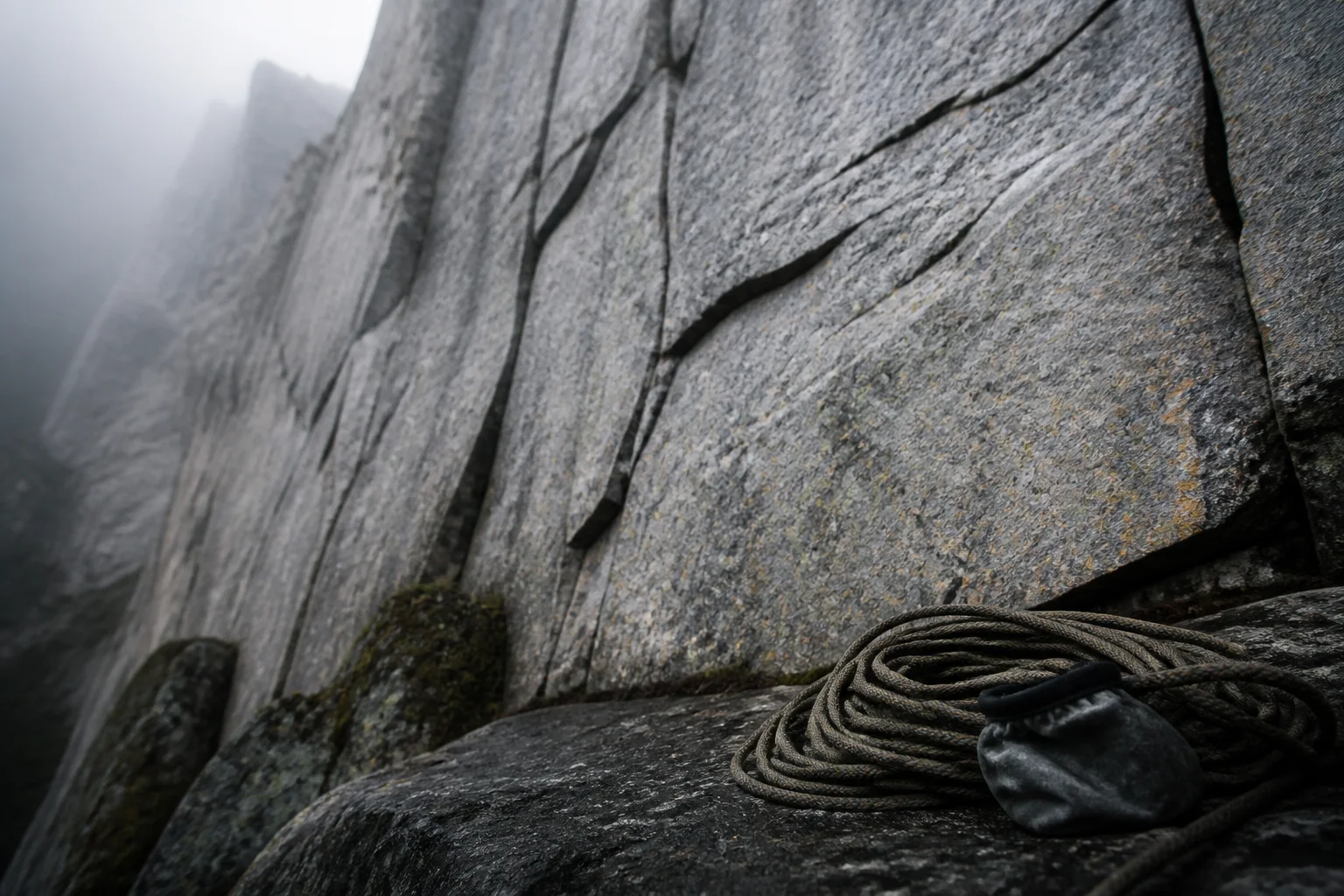
Climbers on rock walls do not smell scents.
Not that they do not want to. On rock walls, smell becomes unimportant. Climbing requires full attention — handhold friction, foot placement stability, center of gravity movement, breathing rhythm. When climbing, every part of the brain is processing sensory information; there is no spare bandwidth for smell.
But when climbers stop — finding a ledge, building an anchor, waiting for a partner to finish leading — smell returns.
There is a scent on rock walls. Not the rock itself. Rock itself, after weathering completion, is inert, releasing almost no volatile organic compounds. The scent on rock walls comes from two things: lichen, and wind.
Lichen is the living part on rock walls. Lichen is a symbiosis of fungi and algae, secreting lichenic acid — the main biological factor of rock weathering. Lichenic acid dissolves mineral surfaces of rock, slowly turning rock into soil. Does lichen itself have scent? Extremely faint — the product of lichenic acid reacting with carbon dioxide in air — a slightly sour, mineral scent.
This scent only appears at specific locations on rock walls: locations with lichen, with moisture, with light but not direct sunlight. Lichen’s required conditions: light but not strong light, wet but not waterlogged, with mineral substrate but no soil cover.
Climbers when choosing handholds often choose rock surfaces without lichen — because lichen-covered rock surfaces have lower friction coefficient, easier to slip. Climbers do not choose places with scent, because scent means moisture, moisture means slippery.
This is probably the only outdoor sport in the world where “the less scent, the better.”
Wind is another presence on rock walls. Wind’s direction and intensity are the climber’s weather forecast. At height, wind comes up from the valley bottom, carrying moisture and plant scents from below — could be smoke from a village downstream, could be pine resin scent from a forest upstream. These scents change with altitude: the higher you go, the more plant scents fade, replaced by “height’s cleanliness.”
Height’s cleanliness is the result of volatile organic compound concentration decreasing after thin air. For every 1,000 meters of altitude gain, air VOC concentration decreases by about 10%. Not because there are no sources, but because the same emissions are diluted by more air.
This is why olfactory experience at high altitude climbing is completely different from low altitude. In cities, the olfactory system works in constant olfactory noise — various scents coexisting, olfactory receptors constantly adapting, ignoring, re-adapting. But at high altitude, olfactory noise almost disappears; what remains are only extremely few scent sources: wind bringing some distant scent, snow’s faint breath, or one’s own breath and sweat.
Extremely clean state is having no scent.
This does not mean high altitude has no scent. It means high altitude’s olfactory experience approaches “no scent.” This state has practical meaning for climbers: it means dry air, clear visibility, stable weather conditions.
But for OPALITESCENT, “no scent” itself is not the endpoint. “No scent” is the background, the canvas, the space waiting to be filled.
The final scent on rock walls is the climber’s own sweat. Sweat evaporates leaving salt crystallizing on rock; salt is mineral. Salt’s scent is the climber’s growth rings: every route left behind a trace of salt, every salt trace is proof of a climb.
Associated Notes: [Mineral] [Ozone]