23 min read
Fengqing's Rainy Night Has a Third Kind of Tea Flavor
Fengqing's rainy night does not belong to the city. Fengqing is a tea-producing place — there is no crowded nightlife in the county town. The sounds on a rainy night are the rain's, the river's, and the sound of raindrops landing on roof tiles. The third flavor of Fengqing is a rainy night.
Fengqing is the home of Dianhong.
Dianhong is the abbreviated name for Yunnan congou black tea, produced in Fengqing County, Lincang City. Fengqing sits along the tributaries of the Lancang River, at elevations between one thousand and three thousand meters, with sufficient day-night temperature variation, sufficient mist, sufficient cloud cover. Tea plants love these conditions: not cold, not hot, not dry, not wet — the slow growth at high altitude gives tea leaves more time to accumulate theaflavins and amino acids.
Tea drinkers know that Fengqing’s Dianhong has a particular “body.” Not strength, not bitterness — body. The sensation of weight that tea liquor carries on the palate. This body comes from the thearubigins in Fengqing’s leaves, oxidized polymer compounds that only fully develop under conditions of long leafing time, slow growth, and high altitude.
The accident happened in Lincang.
Not serious — but serious enough to require observation. The new district of Fengqing County People’s Hospital had just opened; its facilities were the most modern in the entire Lincang area. She was placed in an east-facing room on the fourth floor. Through the window she could see mountains, but not the river.
He did not ask what had happened. He had flown in from Zhejiang — three hours by air, four by road — and arrived at the hospital at nine in the evening. He brought a box of tangerines, bought on the way. The tangerines were from Yunnan; their skins were still green, and when held close, they carried a faint, acidic brightness.
He sat down in the chair beside her bed and placed the tangerines on the bedside cabinet. He said nothing.
She stayed three days.
During those three days, he came each day. Once in the morning, once in the afternoon. Each visit lasted anywhere from thirty minutes to an hour. He did not push her to talk, did not ask how she felt. Sometimes she drifted off to sleep. Sometimes she stared out the window. Sometimes she watched the IV drip, drop by drop. When he came, he sat. Sometimes he poured her water. Sometimes he peeled a tangerine, removed the white pith from each segment, and placed them within her reach.
On the afternoon of the third day, she was cleared for discharge.
He helped her pack, helped her complete the discharge paperwork. The hospital’s new district was genuinely clean — the nurse call system was a touchscreen, the corridor floors were light grey rubber, sound was absorbed into the walls. It was only on her way out that she realized she had seen almost none of the hospital’s full face during those three days. She had been waiting for something without knowing what.
At discharge, he asked: where are you staying?
She pointed to the Wyndham, just beside Yanchi.
The hotel room was on the fifth floor, considerably quieter than the hospital ward.
She opened the window. Yanchi’s water was grey-blue in the afternoon light, the trees along the dam crest casting blurred reflections on the surface. She set down her bag, then went to take a shower.
The hot water from the showerhead was when she noticed the hospital still clinging to her skin — the disinfectant, the rubber flooring, the particular dryness the inside of a hospital nose develops after too many days indoors. The hot water washed it all away. The hot water returned her to her own body.
When she came out, she dressed, sat by the window.
She set the box of tangerines he had left on the table. Beside it was her own luggage, and inside the luggage a jar of tea — the one he had sent her last year. The jar had no label except his handwriting: 120 grams.
She opened the jar and measured out three grams into a gaiwan.
She boiled her own water — not the kettle the hotel provided, which carried a taste of stainless steel. She used bottled water instead. Water temperature: 93 degrees. No higher. Too hot and the liquor turns musty; too cool and the aroma won’t emerge.
Three grams of leaves, 150 milliliters of water. She lifted the gaiwan lid a crack to let the steam escape, then waited.
This is what he taught her — in the hospital, between silences.
He did not lecture. He spoke slowly, while she stared at the IV line. He said the most important thing about brewing tea is water temperature. Temperature determines the manner in which aroma is released, not the quality of the aroma itself — quality is the tea’s own business. Temperature merely opens it. If the opening is wrong, what is inside cannot come out. If the opening is right, it opens by itself; you do not force it. He did not look at her when he spoke; his eyes were on the window or elsewhere, as if the words were addressed to the air.
Thirty seconds. She poured the first steep into a cup. The liquor was transparent amber, with a faint reddish tinge at the edges — the color of thearubigins fully released at the correct temperature, meaning the water had been right.
She drank the first steep. First a thin layer of astringency on the tongue, then a fullness of aftertaste sweetness. The weight of the tea on the palate was correct — not light, not airy, but present, substantial. This substantiality came from the tea itself: from that particular mountain, that river, that altitude, that day-night temperature differential.
The second steep could extend to forty-five seconds. As she poured, a cloud drifted across the sun and dimmed the light through the window. She glanced up briefly, then returned to the tea.
During the third steep, she smelled rain.
The sound of rain falling in Fengqing is different from elsewhere.
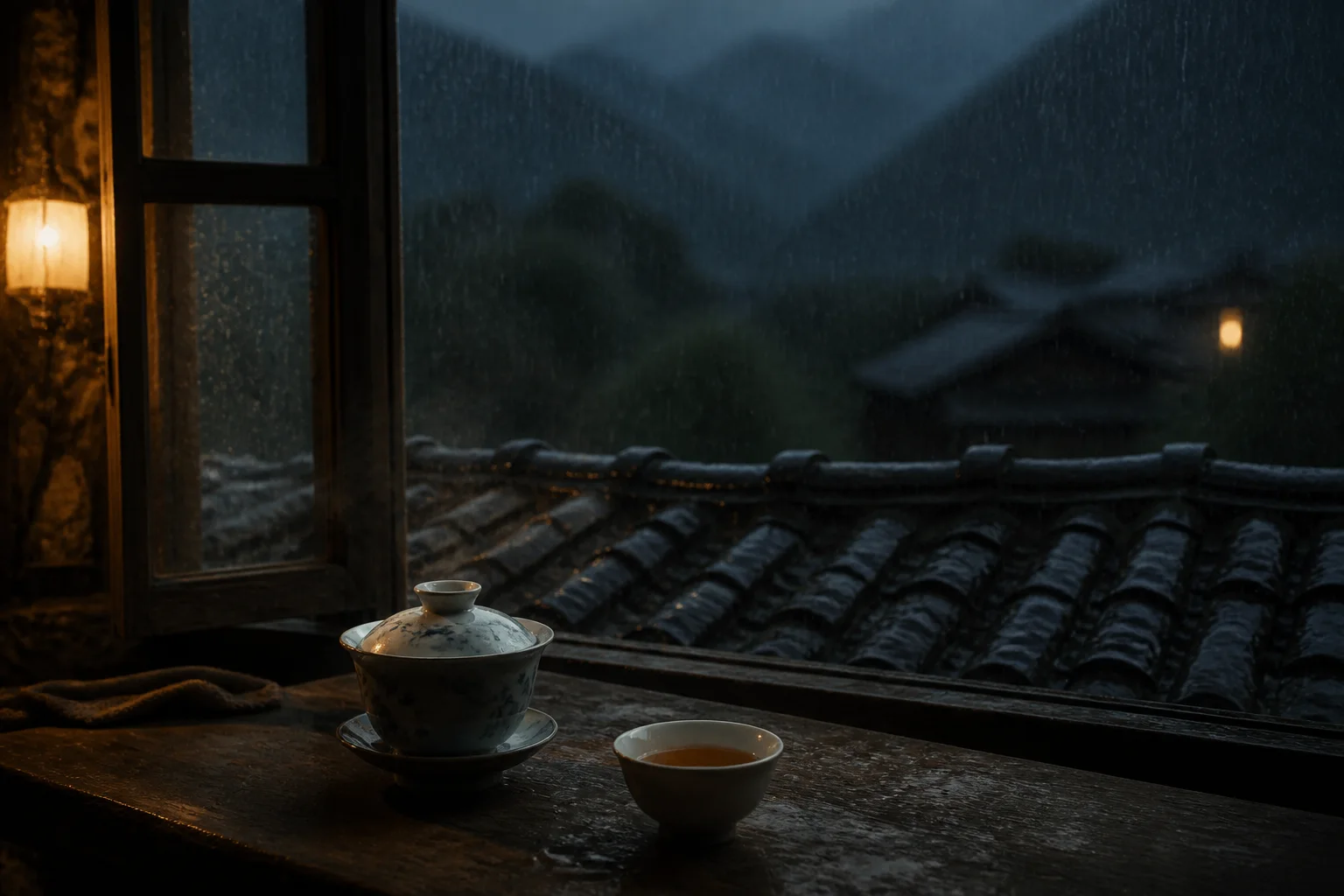
Fengqing is a mountain town, and rain falling on the tiles of rooftops produces a resonance with an undertone of wood — the sound reflecting off the rafters and beams beneath the tiles. Old houses use grey tiles whose glazed surfaces have been worn over time, so rain falling on them produces a dull, dispersed sound rather than the crisp tone of newer tiles. Fengqing’s rain sound has a temporal thickness: new tiles ring, old tiles muffle — the older the tile, the more the sound retreats inward.
She opened the window. Rain fell on the surface of Yanchi.
Yanchi is the artificial reservoir beside the hotel. Calling it a reservoir is perhaps misleading — it functions more as an environmental landscape. Trees grow along the dam crest, egrets occasionally rise from and settle on the water, and when it rains, raindrops on the surface produce a dense pattern of fine ripples, like a page filled with small parentheses.
The page has no writing on it.
Yanchi’s water comes from a tributary of the Lancang River system. The water is clear, low in hardness — the mineral content is not high, so the tea liquor brewed with it is exceptionally bright. Soft water produces sweet tea; hard water produces full-bodied tea. Fengqing’s water runs soft; Yanchi’s is even softer.
During the third steep, when the tea had reached its most interesting point of subtle bitterness, the rain grew heavier.
The second sound of a Fengqing rainy night is the river.
A small river runs through Fengqing’s county town. Its name on maps is the Fengqing River, but locals simply call it “the river.” The river is not wide — ten meters or so. During the rainy season the water level rises, but never enough to overflow the banks. Weeping willows grow along the riverbank, their branches hanging even lower in the rain, as if looking down at their own roots.
The river’s sound is louder at night than during the day. In the daytime, voices fill the county town — people talking, vehicles passing, chickens and dogs making noise — and the river’s sound gets buried. At night, all of those sounds disappear, leaving only rain and river. The two intertwine until it becomes impossible to tell them apart.
What is the sound of a river? The sound of water flowing over stones. As water passes over stones, it produces bubbles; when those bubbles burst, they create subtle crackling sounds. Every stone has a different shape, every flow a different pattern, so every river’s bubble-burst sounds are unique. The more stones on the riverbed, the denser and more intricate the river’s sound becomes.
Fengqing’s riverbed has many stones. The people of Fengqing have never cleared the stones from the river channel — those stones have become part of the river, the way old tea plant branches become part of the tea plant rather than something foreign to it.
During the fourth steep, the tea liquor had grown thin, but a light astringency lingered on the palate — the sensation left by tea polyphenols, as if the post-rain air had gently pressed down on the tongue.
Fengqing’s third flavor is a rainy night.
This is not the smell of going outside on a rainy day — that smell is ozone, damp earth, washed leaf surfaces. The smell of a Fengqing rainy night is what you perceive indoors: entering through the window, seeping through the walls, carried in on the fragrance of the tea itself.
This smell progresses in stages: first, the dampness from the river valley comes through the window; then, the pine resin smell from the mountains; finally, wood smoke drifting from some distant village — a village probably at higher elevation, where the smoke is lighter and cleaner than village smoke in the valley.
These three smells layered with the tea aroma form the “compound fragrance” of a Fengqing rainy night: water in the tea, moisture in the air, pine resin in the moisture, smoke in the pine resin, night in the smoke.
The fourth steep is the most interesting steep of Dianhong: the thearubigins have largely released in the earlier steeps, leaving mainly amino acids and residual polyphenols. This steep is not full-bodied — it is sweet. Not the sweetness of sugar, but the sweetness of aftertaste. The palate experiences a flicker of bitterness first, then it vanishes, and then from the back of the tongue a clear sweetness slowly emerges. This progression lasts about three minutes.
Three minutes later, the rain stopped.
Yanchi’s surface regained its stillness under the lamplight.
During the fifth steep, she stopped.
It was not the tea — the tea could have continued. Dianhong is highly resistant to steepings; a normal Fengqing Dianhong can endure seven or eight steepings. But after the fifth steep, the connection between the tea’s flavor and Fengqing began to fade. The tea is still from that same tea tree, but the Fengqing in the air had begun to dissipate: the rain has stopped, the river’s sound has softened, the moisture is retreating toward the mountains.
He had never written a word on the tea jars. 120 grams. One jar each year.
She finishes that jar each year, around November. On the night she finishes it, she thinks of Fengqing’s rainy night, the sound of the river, the shape of the mountain visible from the hospital window, the veins on the back of his hand as he peeled a tangerine.
He taught her nothing. He only drove seven hours, brought a box of tangerines, sat in the chair beside her hospital bed, and said: water temperature for tea, 93 degrees. No higher.
On the sixth steep, she left the liquor in the cup and did not pour it out.
The rain had fully stopped. From the direction of Yanchi, a bird called once, then fell silent. The three smells still hung in the air — the dampness of the river valley, the pine resin from the mountains, the distant wood smoke — they had seeped into the walls of the room, into the jar of tea she had brought with her.
He was somewhere in Zhejiang now. Perhaps making tea. Perhaps not.
Associated notes: [Tea] [Wetland] [Mineral]