6 min read
The Beauty of Imperfection: Why Our Bottles Don't Pursue Symmetry
Perfection is a static state. Imperfection is an ongoing state. What is static is dead; what is ongoing is alive.
Perfection is a static state.
A circle perfectly round stays there forever. It does not grow, does not change, does not respond to anything. A perfect piece of glass has no surface friction; nothing can stick to it.
Imperfection is not a flaw. Imperfection means something is in progress.
Moss on a stone is imperfect—the edges of moss are uneven, the thickness is uneven, each patch has its own shape. But precisely because moss is imperfect, it is alive—it expands outward a millimeter each year, it is greener when water is ample, drier when conditions are arid, it responds to its environment.
A perfect glass does not respond to its environment.
The imperfection of natural materials is their life characteristic.
Cold-pressed citrus, top note lasts only thirty seconds. After thirty seconds, it is gone. Synthetic citrus can last thirty minutes, but its thirty seconds and its thirty minutes are the same—it does not change, does not begin, does not end, only volatilizes linearly.
Natural materials are not like this. Each stage of natural materials is different: top note molecules evaporate first, heart note molecules next, base note last. They have a process, a beginning, a climax, and an ending. They unfold in time.
This is why natural materials smell more “real”—not because their components are closer to “real scent,” but because they have the characteristics of “authenticity”: a beginning, a process, an ending. Not an infinite loop, but one-time only.
There is a Japanese term: “ichigo ichie.” Meaning: this moment will only happen once. When you meet again at the same place, with the same person, with the same fragrance, it is not the same moment. “Ichigo” is time, “ichie” is encounter. The aesthetics of ichigo ichie: precisely because it will not come again, it is worth something.
This is OPALITESCENT’s fundamental position.
We do not pursue extending fragrance indefinitely. We pursue giving fragrance, during its existence, sufficient weight, sufficient reality, sufficient honesty. When it ends, it ends. It does not pretend it is still there.
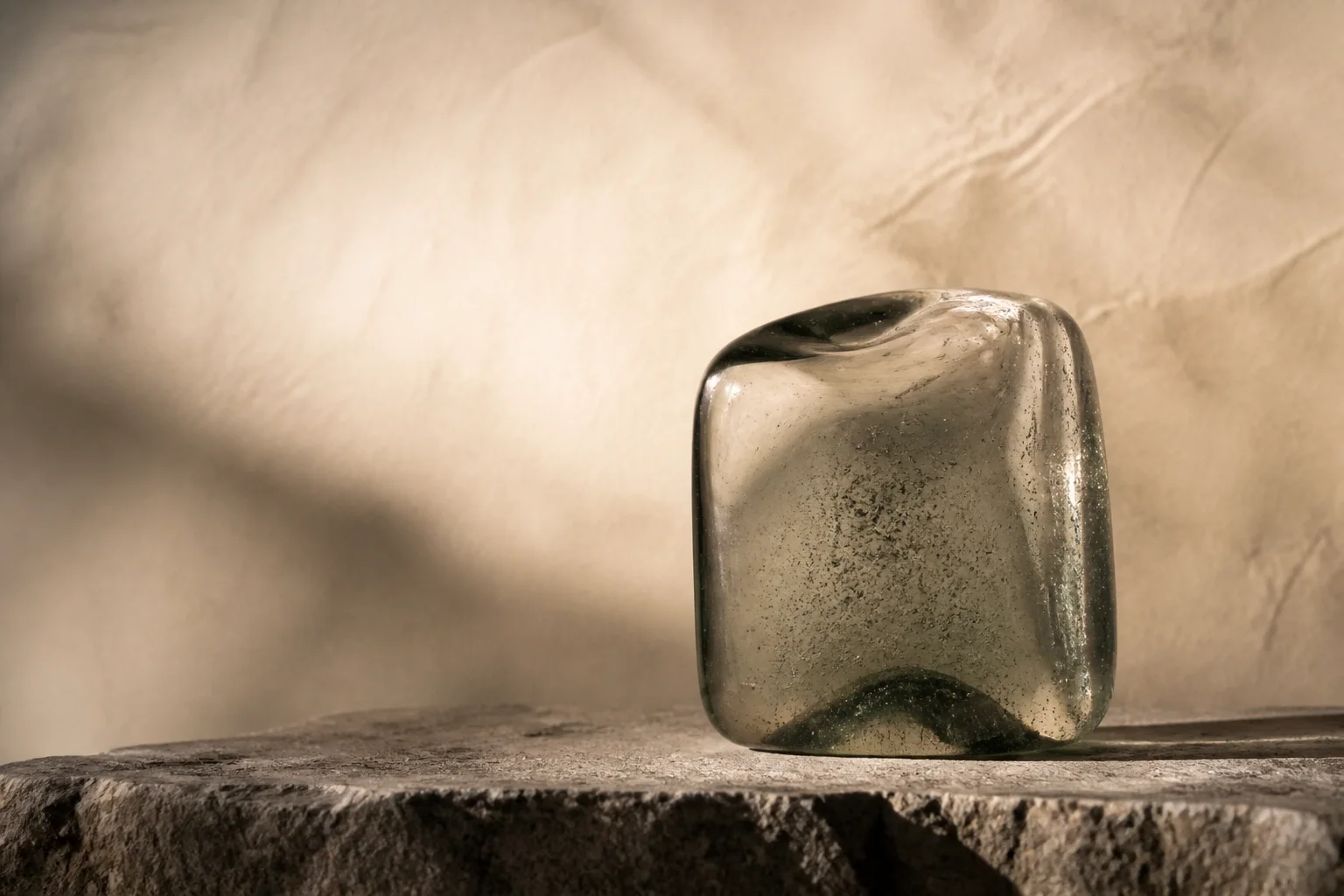
A bottle that does not pursue symmetry follows the same logic. Symmetry means it looks the same from any angle—it has no front, no back, no particular angle. Every direction is the same.
A bottle that does not pursue symmetry has its front, its back, the angle where light hits it and the angle covered by shadow. It has its good side and its not-good side. Asymmetry means it has its own shape, not a copy of some ideal.
The not-good side is also part of it.