5 min read
The Curved Path of Aurora
Aurora is the path solar wind takes as it deflects through Earth's magnetic field. Solar wind consists of charged particles. It does not travel straight—it follows magnetic field lines. The magnetic field lines are curved. So aurora is curved too.
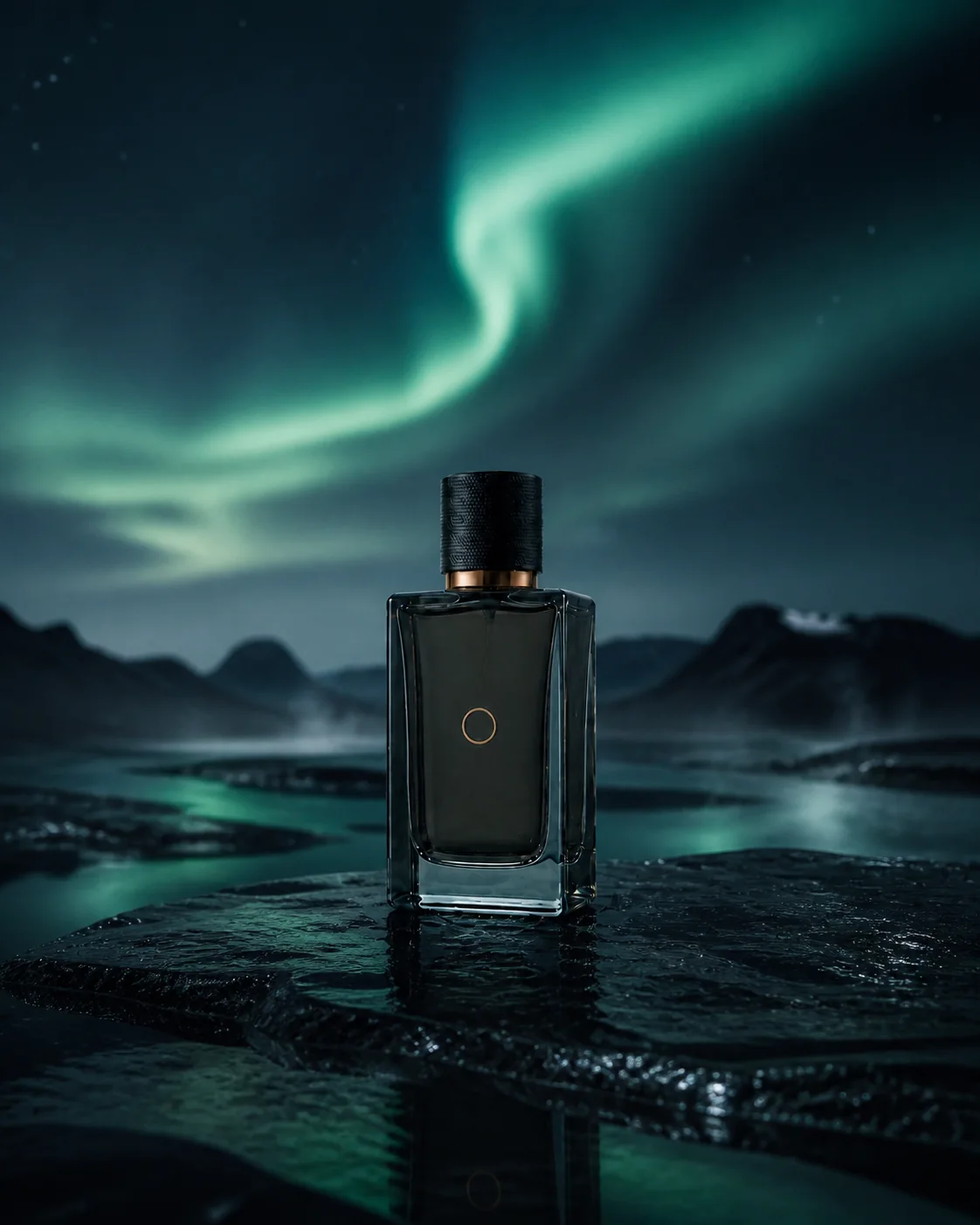
Aurora is curved.
It is not a curtain hanging from the sky. It is the path charged particles take as they deflect through Earth’s magnetic field—solar wind consists primarily of protons and electrons, captured by the magnetic field, moving along its lines. The magnetic field lines are vertical near the North Pole, tilted at lower latitudes, so the particles’ trajectories are curved.
Curved is what aurora is. Straight is not.
The perfumer saw the aurora in Fairbanks, Alaska. It was December, eleven at night. A green light suddenly appeared in the sky, then a second, then a third. They did not stay fixed—they moved, curved, flowed like water.
The green of aurora comes from oxygen atoms. At altitudes between one hundred and three hundred kilometers, oxygen atoms are struck by high-energy particles, jumping from ground state to excited state, then falling back, releasing green light at a wavelength of 557.7 nanometers. At this altitude, atmospheric density is precisely right for green to be the most prominent color—too low or too high, and the oxygen atoms cannot emit this color.
The color of aurora is an altitude problem, not a matter of whim.
Aurora, the fragrance. Top note is cool mint. Not spearmint, not peppermint—mint that grows in truly high-latitude cold regions. Its menthol content is lower than ordinary mint, but its scent is sharper, more “icy.” That sharpness comes from the cold itself: plants growing in cold produce more polyols to protect cell membranes, and those polyols bring that “icier” texture.
Heart note is wetland moss from the Arctic region. Moss grows in high-latitude wetlands, with extraordinary water absorption—up to twenty times its own volume. Water-absorbing moss has a particular scent: the smell of water plus the plant itself plus the scent of slowed metabolism at low temperatures. Three things mixed together, becoming a scent of “no sound.”
No sound is not silence. No sound is sound reduced to almost nothing.
Base note is ozone. Ozone is the equivalent of aurora—both are effects produced when charged particles move through a medium. Aurora is charged particles in the atmosphere; ozone is what oxygen molecules in air become under ultraviolet radiation. Their commonality: both are “air that has changed its form.”
Aurora curves. The magnetic field determines its path. Fragrance does the same—not doing whatever it wants, the medium determines its shape.
Associated Notes: [Aquatic] [Ozone]
Land & city
Orbit's Critical Point Does Not Deviate
Land & city
Nebula's Rose Has No Scent
Land & city